
Diary of an elective student
When the lights go out
This week we look at the reality of doing humanitarian offender healthcare in a part of the world prone to power cuts at the best of geopolitical times…
Rachael on Power past…
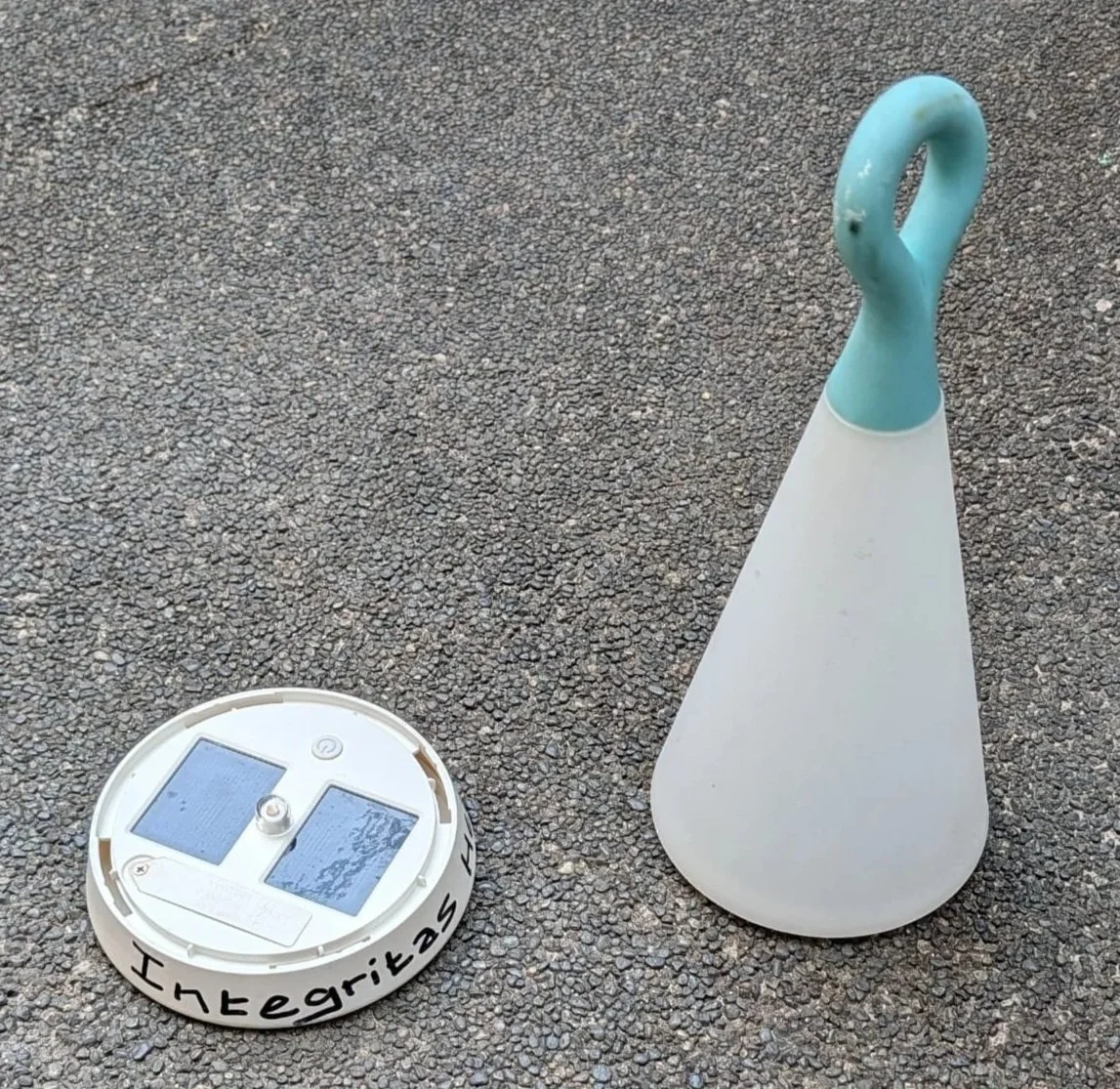
Back in 2015 we invested in Ikea’s very finest solar lamps. They’re still working great but do need regular pre-charging.
It’s been just over a decade since I started managing Integritas’ work in the Philippines as a provider of humanitarian offender healthcare.
Right from the off, I had to get used to brownouts - the local term for electricity cuts. Sometimes they just happened whenever demand exceeded supply, especially just before and during the Monsoon. Other times they were pre-planned by the electricity companies, in order to conserve power for the days ago. I found it amusing that any announcements about planned cuts were posted on Facebook rather than organisational or government websites.
After the pandemic, things improved a lot. I almost forgot about brownouts - until the middle of this month, which coincided with the arrival of Asam, Ben and Jack. They joined Isaura on our 2026 elective program: she’d already been out with us for two weeks and has blogged already about her first time in jail. All four of them are young European doctors with no prior experience of living and working with power cuts. So I asked each of them for a viewpoint on the power situation…
…present…
Asam on exhaustion
The Philippine climate is exhaustingly hot and humid. Having arrived off the Manila to Olongapo bus this Tuesday, I was grateful to step into a residence with air conditioning (A/C). This place serves as a clinical base as well as being a home-from-home for us during our placement.
Fast forward 24 hours: we’d just had dinner, and were about to sit down with a coffee to finish our in-person induction. This was necessary before we could be unleashed onto patients. Without warning, power went out right across the city. It was a brownout. Not only could we not finish our training session. It was also too hot to stay inside the base. Instead, we were encouraged to go outside into the night air and explore Olongapo whilst waiting for the electricity to return.
Taking the opportunity to unwind and feel a little closer to home, I decided to visit a local gym. I failed to realise was that the brownout would continue for several hours. Although the gym had a backup generator to keep its lights on and exercise machines working, running its A/C was too big an ask. The gym quickly became comparable to a sauna. I had to cut short my workout. My clothes were so soaked in sweat, it was like they’d just come out of the washing machine! Back at our base a few hours later, it was a relief when the lights and A/C came back on.
My personal discomfort was put into perspective the next morning when I visited sick detainees in my first place of detention (PoD). Even before the sun reached its peak, I found it almost unbearably hot. We weren’t there that long, and then I returned to our base to eat and have a siesta in the cool of my A/C-ed bedroom. I wondered, what on earth must it be like for my detained patients? They are stuck together, for days and weeks on end, in the same small, under-ventilated furnace of a cell.
Ben on consequences
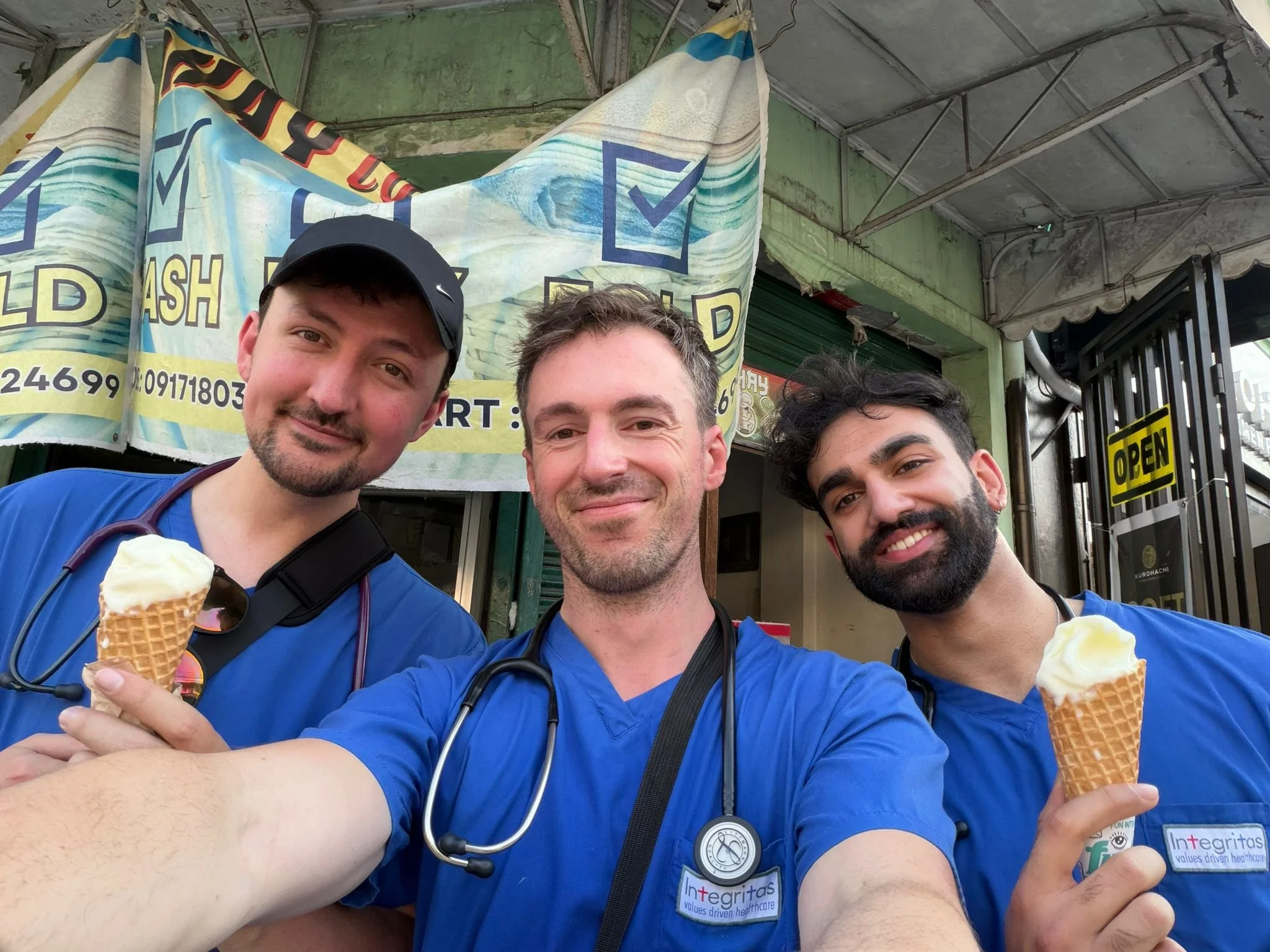
Ben, Jack and Asam cool off in-between patients
The problems in the Strait of Hormuz have lead to ongoing high fuel prices and global energy shortages. In the run-up to this elective, someone close to me voiced a concern about the potential risks of travelling at this time to the Philippines, which has been forced to go into emergency measures. At that time, I was still in the UK: I felt relatively comfortable that the War in Iran wouldn’t affect me in this way. So I put this concern to the back of my mind.
Fast forward a couple of weeks and, on the second day of our placement, suddenly we lost power across the entire city. Apparently it was a planned shutdown to conserve energy… but no-one told us or our supervisor. In fact, it also seemed to be a complete surprise to the Filipinos working with us.
Even though the power came back on late evening, the brownout had consequences for the next day. Our schedule was profoundly affected. We had to finish our induction that morning and defer our first patient-facing activity until the afternoon. And as another planned brownout had been announced for that afternoon (but funnily enough didn’t happen until - in unannounced fashion - the following day), our supervisor too had to be taken away from patient-facing work. Instead, she worked with our housekeeper to resurrect our base’s pre-pandemic brownout action plan.
Geopolitics affect the Philippines and other climate-challenged low-and-middle-income countries (LMICs) far more than my home country of the United Kingdom (UK) and other high-income countries (HICs). We are so sheltered and privileged in Europe and the wider western world. Decisions made by our politicians ripple and magnify as they cross the globe.
Jack on prescribing
This was my first week serving with Integritas. I hadn’t been sure what I might face whilst caring for detainees in PoDs and living & working in the Philippines. The first brownout was a real surprise. When it hit mid-evening, the rapidly rising inside temperature forced us all to decamp into the courtyard. Initially all I could think about was that it was dark and hot. But then I realised that the brownout posed a much bigger threat to me in particular…
I’m an insulin-dependent (or type I) diabetic and I use insulins that are hard to source out here. So I brought out all the insulin I might need with some to spare. It has to be stored within a specific temperature range, and it had already been accidentally frozen in a Manila hotel’s over-enthusiastic fridge. What was going to happen now, at the other end of the temperature scale? Suddenly my own health and well-being was under threat.
My supervisor reassured me that all our fridges - both the domestic ones and those used to store medication for our clients - are monitored by max-min thermometers, so we would know if my insulin had got too hot. I understand though that, in many Philippine pharmacies and other places that have to stock medicine, this is not the case. And what about all the other insulin-requiring patients storing insulin in their own homes, especially those who are too poor to afford fridges (or refs as they are known out here) at the best of power times? Is their insulin actually denaturing and so being less effective?
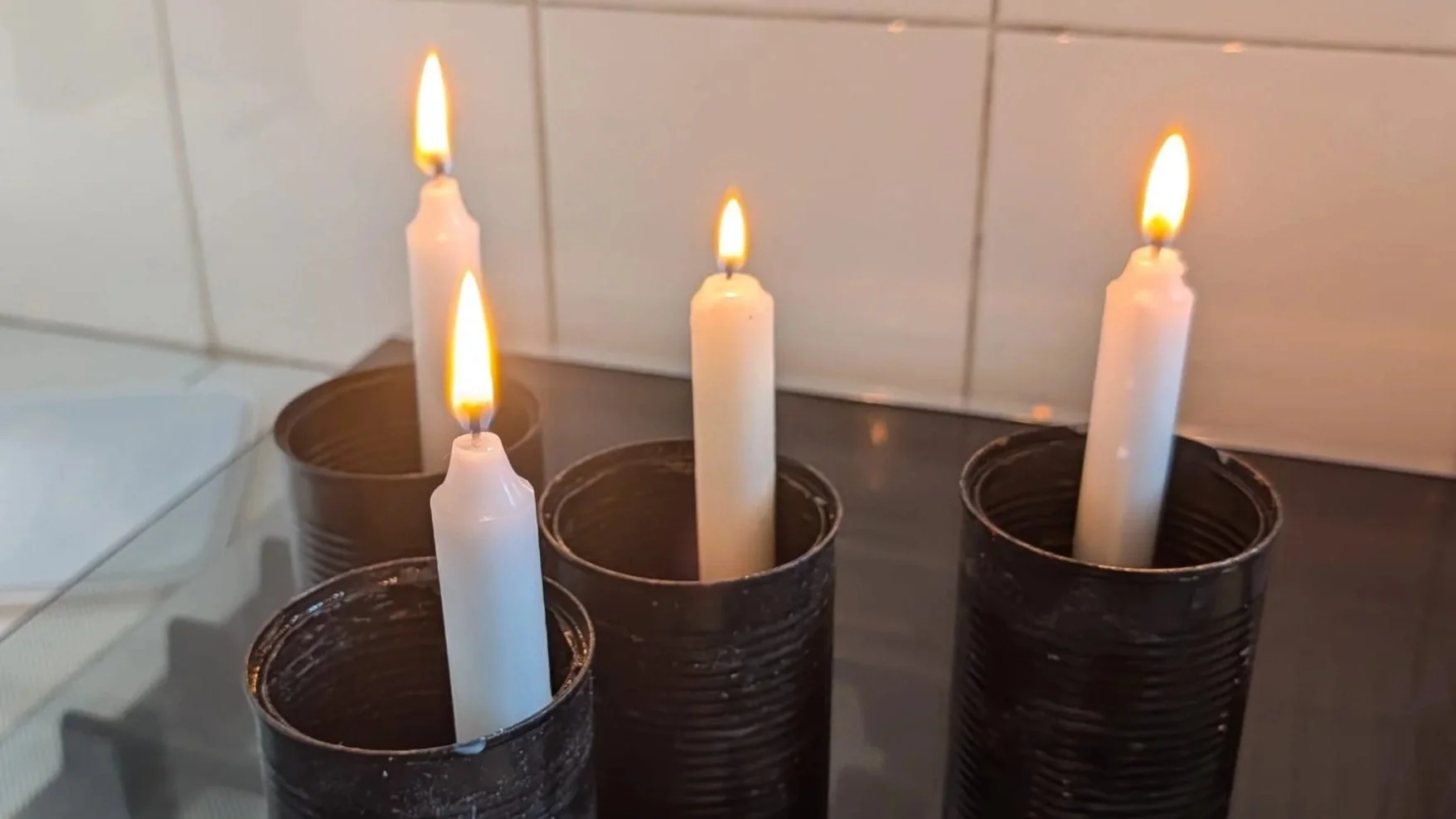
The next day, we learned that there would be more rolling brownouts as the Philippines struggled to deal with the consequences of the War in Iran. And so Integritas reintroduced its brownout action plan: candles and matches in every room, hand-held solar powered lamps, and freezers stocked with loads of cool blocks. Whenever we go a block is placed in the ref right next to my insulin, just in case an unannounced brownout occurs before we get back.
Situations like this teach you to think on your feet, force you to get creative, and help you learn not to let challenges get the better of you.
Isaura on empathising
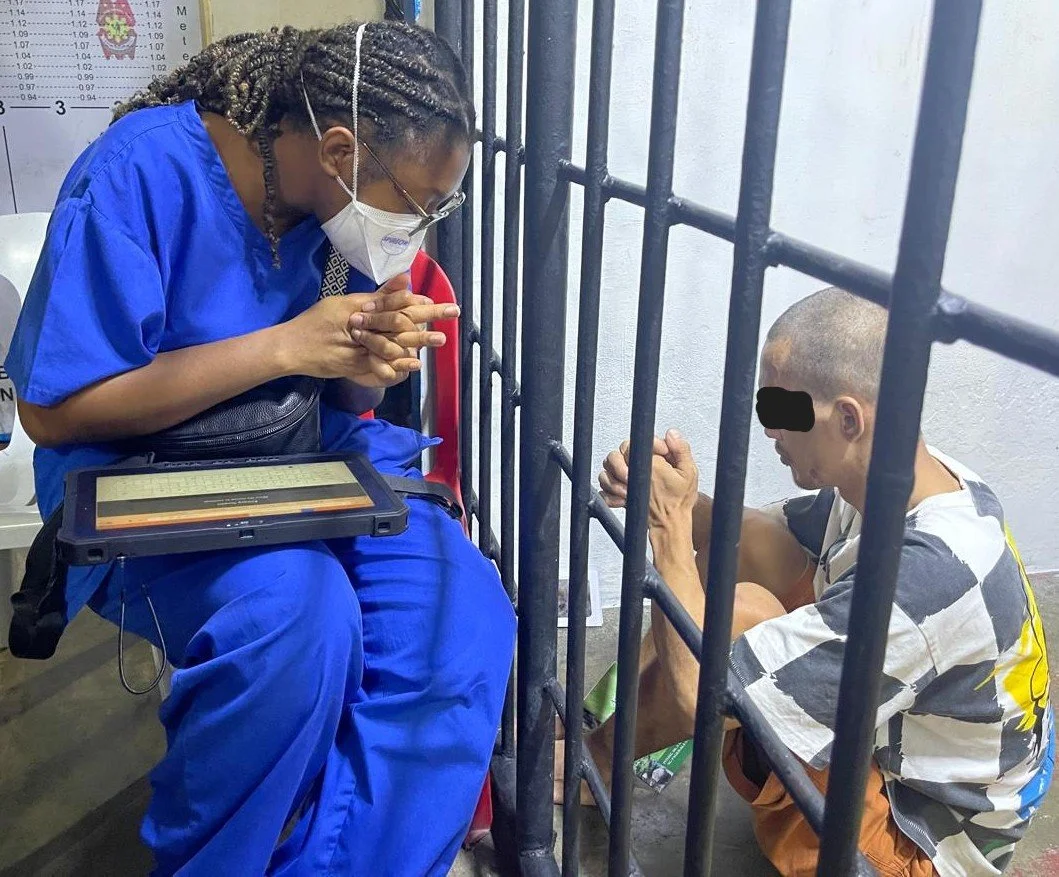
Isaura doing a hot and sweaty cell-side clinic
Over the last two weeks, whenever I’d approached a typical Philippine cell I’d generally found a small fan (of more or less power) set up in front of the bars and pointed towards the detainees. For me, sat on a stool consulting from the other side of the bars, it had sometimes felt like my detained patients were getting more breeze than me. My scrubs were soaked with sweat after just 15 minutes!
Then, during that first brownout, I observed free Filipinos going outside into the evening air, which is a bit more breezy than during the day. I wondered what it must be like for my detained patients right then, being stuck without any kind of ventilation and not able to go to a window yet alone venture outside. Being locked in a blisteringly hot, airless space, soaking in my own sweat and surrounded by the sweat of many others is the stuff of nightmares to me. Yet it is reality for so very many detainees around the world.
… and future
Thinking personally: I’ve worked in the tropics for over ten years now. The temperature in the jail I was in yesterday topped 50 degrees! To an extent, one does get used to working in such extreme conditions. After all, that’s the nature of human homeostasis. But it is exhausting and does impact one’s long-term health. On top of the physical risk though, working behind bars often impacts one’s own mental and spiritual functioning. We healthcare professionals working behind bars everywhere need to take care of our own holistic health.
Thinking for Integritas: I’m now regretting getting rid of our back-up generator! That said, during such crises, the fuel to power it may become prohibitively expensive and scarce. We need to look at other options such as solar power, which of course is good during times of geopolitical calm and crisis. True, installing such a system has large upfront costs. But it’s far better for the environment both short-term and lost-term. These times of trial should force us to think calmly, creatively, and ‘green-ly’.
And finally, thinking for all detainees everywhere: most countries of the world have signed up to the UN’s Convention Against Torture and Cruel or Inhuman Degrading Treatment or Punishment (CAT). Yet keeping detainees in over-heated, under-ventilated, over-crowded prison cells is a form of environmental ill-treatment. And so, as our world gets hotter through the effects of climate change, each country needs to think urgently about how to reduce the temperature, increase the ventilation, and decrease the population of its places of detention.
Drs Ben Barnes, Asam Iqbal and Jack Meadows are from City St George’s University, and Dr Isaura Koroma is from the University of Sunderland. They are all studying on our elective program prior to starting work as doctors in the UK’s National Health Service (NHS) in August.
Dr Rachael Pickering is their supervisor.
Their opinions do not necessarily represent those of Integritas Healthcare.
29th May 2026