

Sick at Christmas
In this, our last blog of 2025, we look at how detainees cope with things like influenza at this time of year…
Busy+++
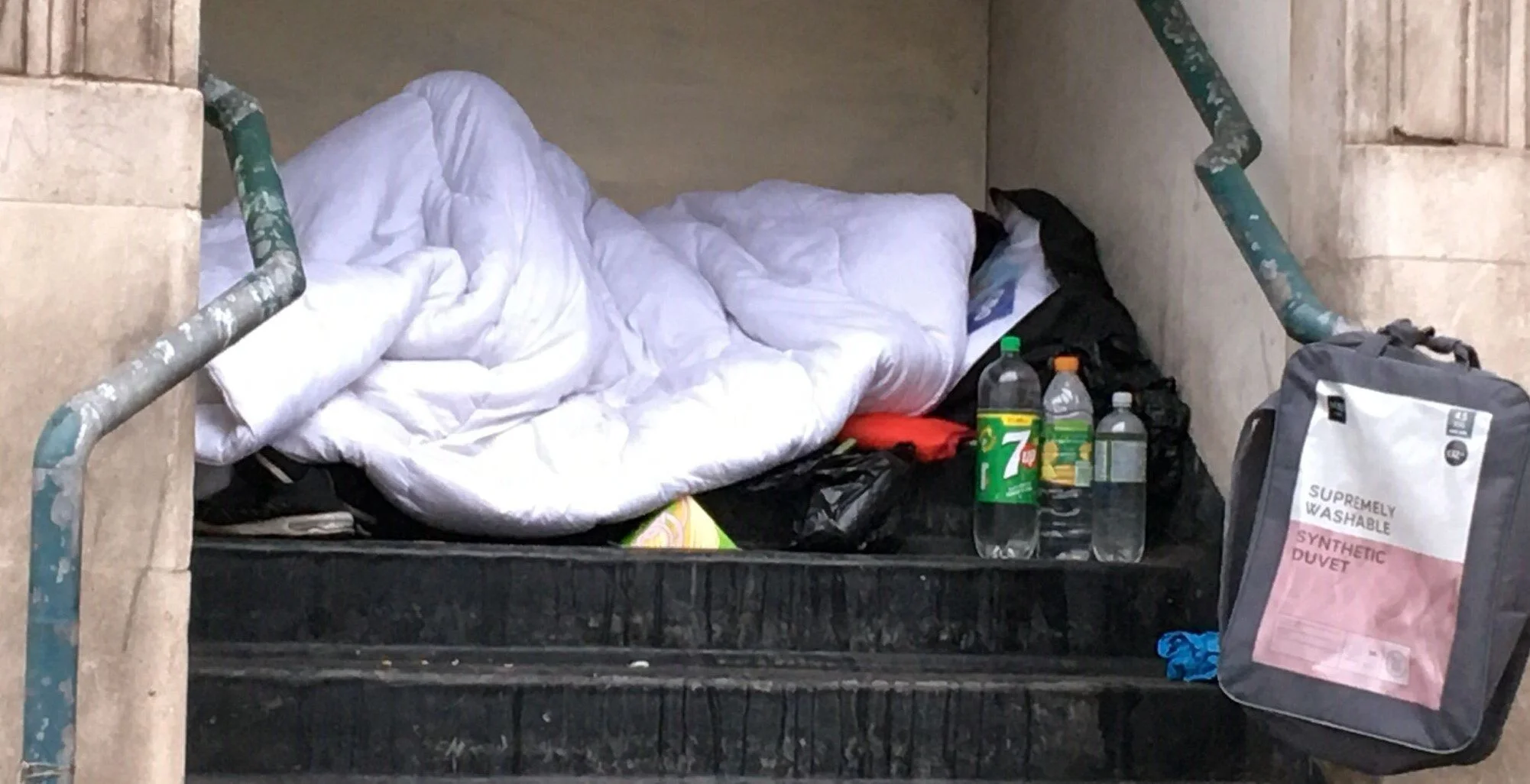
Many rough sleepers end up sick and in prison
Right now I'm on my way home from the Boxing Day duty doctor shift in one of London’s many prisons. It's always busy there, but today could best be described as busyness suped up on steroids.
First there were all the new arrivals from the police stations via the courts - as crime doesn't stop for Christmas - with many of them withdrawing from both drugs and alcohol. And making things worse at this time of year is the fact that a lot of substance misusers arrive with nasty chests due to rough sleeping throughout the harsh weather.
Then on the wings there were lots of chronically sick men with complex mental health conditions inter-playing with long neglected physical ailments. There was the usual blob of inter-prisoner violence. And then there were several acutely unwell men, suffering from things such as severe flu, and it was one of these who caused me the most concern during the day.
Properly sick
At home…

Home is especially sweet when sick
Think back to the last time you were ‘properly sick’ with something like influenza or pneumonia? No doubt you had a fever. What helped with this? Maybe you decided to take a nice cool shower or have a steamy bath. How many pillows did you prop yourself up with in your bed next to a wide open window? Perhaps a nice caring family member popped out to the pharmacy to get medicines for you.
And did you need urgent medical attention? If so, maybe you called a cab or even an ambulance to get you to a clinic or hospital. Or did the paramedic or doctor come to you? There are several ways of accessing unscheduled medical treatment within a high-income country like the UK. You are an autonomous being with many options.
… and ‘away’

Healthy or sick, being imprisoned is a critical challenge to one’s autonomy
What about being sick behind bars though? Can you think what it must be like to be really ill and yet be trapped in a prison cell? Imagine that you're in prison - let’s make it a UK one - and develop a severe dose of flu with a high fever, shortness of breath, blinding headache and pains all over, plus vomiting and diarrhea. The heating is on full blast and non-adjustable, the window doesn't open, and you can't wander off down the landing to take a cooling shower. Most likely you're sharing your cell and its integral toilet with a complete stranger. You've got a 50% chance of being on the top bunk, nigh on a 100% chance of it being paired with a saggy mattress, and one pillow if you’re doing well. And most critically, the door is locked and your only recourse to help is your cell's call bell.
Prisons are always busy, some days more than others, and it can take ages (and ages and ages) for someone to answer the bell. Then they have to radio for a nurse who is also busy. (S)he will take your observations and may decide to give you paracetamol for your fever. If concerned about your condition, (s)he’ll ask a doctor (like me today) to come and see you, and again this can take an age. And then anything I prescribe, such as antibiotics, can take time to finally arrive in your stomach. Even then, you won’t feel instantly better! You may (or may not) start to improve or you may get an awful lot worse. And each time you decide to ask for a review, once again you're at the mercy of the call bell.
You 0 The System 100
Dependence
These stark differences, between being sick at home and away in prison, boil down to a drastically reduced degree of autonomy. When a judge deprives you of your liberty, that in itself is a serious blow. Most of us free citizens live our lives with a high degree of independence and autonomy. Sometimes we only learn to value something when it’s taken away. And the way most of us like to access medical help relies on a high degree of autonomy. During a health crisis in prison, you are almost totally dependent on the goodwill and professionalism of others.
Equivalence
It’s important to remember that judges hand out deprivation of liberty. They do not order deprivation of healthcare.
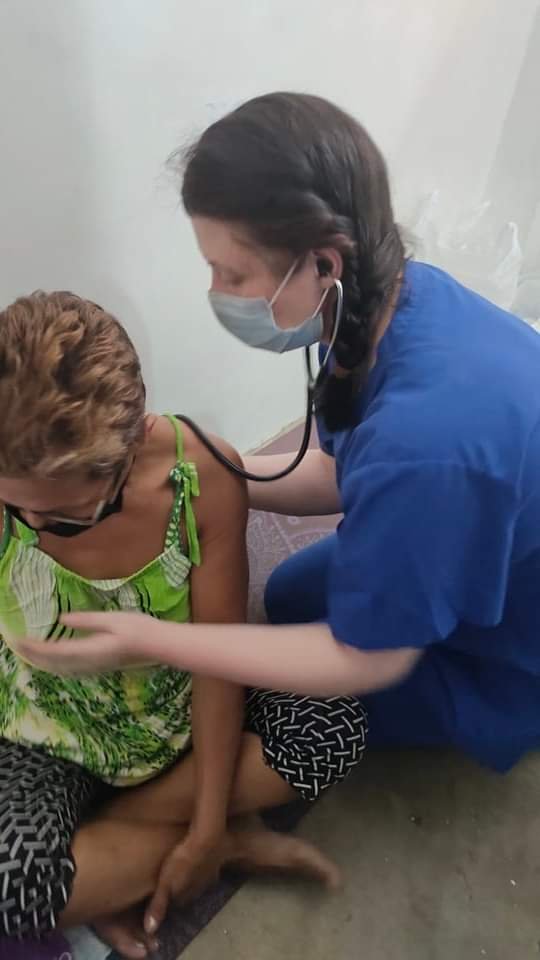
Assessing a sick detainee in the tropics
In global terms, my London patients, and indeed detainees in most other high-income countries, are very lucky indeed. They are detained in countries that have commissioned systems of offender healthcare in all their places of detention.
And many of these systems - including that in the UK, which is run by our National Health Service (NHS) - recognize the principle of equivalence of care. In a nutshell, this means that prisoners should enjoy the same standard of care as those in the community, though the means of this care delivery may have to vary.
Non-delivery
Let’s think about the rest of the world though. There are almost 12 million detainees behind bars right now. What about all the sick ones in countries that don’t have adequate or any commissioned offender healthcare?
I’ve seen many such detainees in my capacity as the chief medical officer of Integritas Healthcare, a non-government organisation (NGO) that does humanitarian offender healthcare in places including the Philippines where the state does not oblige. It’s truly pitiful to see the condition that some of them end up in. And the numbers we can help are paltry in the grand scheme of things.
The state of things
Charity v State
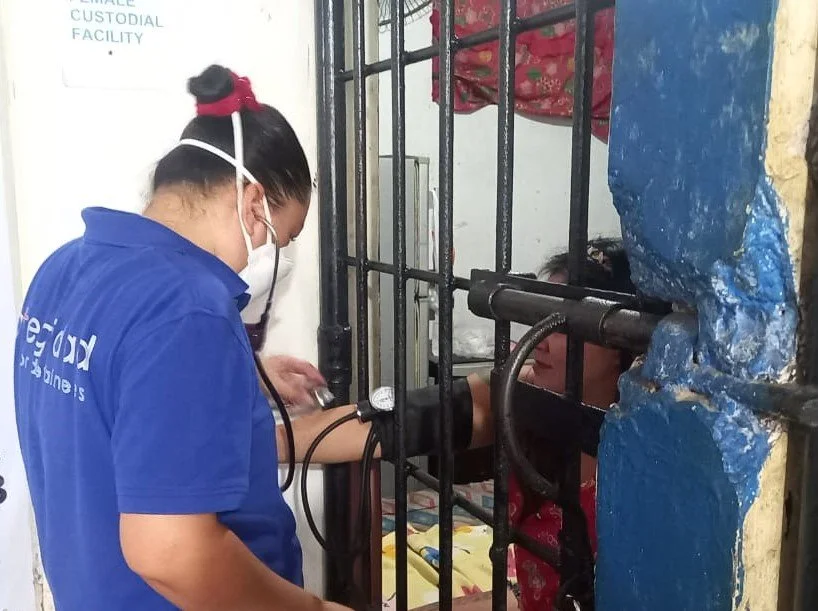
One of our caregivers, Mam Angie, assessing a sick police detainee
NGOs both small (like Integritas) and big (like the Red Cross) shouldn’t have to care for detainees. Yes, it’s time for all the countries of the world to recognize that healthcare is a human right to which detainees are still entitled as they haven’t left their human rights at the prison gates.
Right to health
For the general population, the ‘right to health’ involves more advanced legalese than many of the other human rights. Yet for detainees it’s relatively simple. The argument goes as follows:
It’s generally accepted that neglecting a detainee’s health is a form of ill-treatment.
Like frank torture, ill-treatment is prohibited by international human rights law:
No one shall be subjected to torture or to cruel, inhuman or degrading treatment or punishment.
Article 5, Universal Declaration on Human Rights
No one shall be subject to torture or to inhuman or degrading treatment or punishment.
Article 3, ECHRTherefore detainees have the right to health and therefore to state provision of offender healthcare.
So if a state removes a resident’s liberty and therefore also his/her autonomy to seek healthcare as (s)he sees fit, then that same state should provide him/her with a decent standard of offender healthcare.
What value health?
At the end of the day, how a state treats (or does not treat) someone is a reflection of how it values them. No-one knew this better than the late President Mandela, the first black president of South Africa who - prior to this elevation - spent decades in detention for his human rights activism:
It is said that no one truly knows a nation until one has been inside its jails. A nation should not be judged by how it treats its highest citizens, but its lowest ones.
Nelson Mandela
He will forever be associated with decency in offender healthcare, as posthumously the UN named their updated universal prison standards guidance after him. And the first rule in its healthcare section says it all:
The provision of health care for prisoners is a State responsibility. Prisoners should enjoy the same standards of health care that are available in the community, and should have access to necessary health-care services free of charge without discrimination on the grounds of their legal status.
Nelson Mandela Rule 24(1) (emphasis added)
Many of the states that don’t provide their detainees with substantive or even any official offender healthcare use the well worn argument that it is just too expensive. Yet many of these same countries imprison the most people, at great cost. Their judicial systems could imprison far less people: they could bail most pre-trial detainees, and hand out more non-custodial sentences. Of course, such changes would need much willingness, inter-government departmental liaison, likely some law changes regarding non-custodial sentencing, and much time. But eventually, the vast amount of money saved would more than cover the provision of offender healthcare for those whose detention is deemed essential.
At the end of the day, how each non-compliant state is persuaded to make the necessary changes will vary. These are individual, very long games to be played. But play them we must. Because the right to health doesn’t get checked at the prison gate.
Dr Rachael Pickering is our Chief Medical Officer. Her views do not necessarily represent those of Integritas Healthcare. If you’d like to help our work, all donations towards our winter appeal are most gratefully received.
I was sick… and in prison and you came to visit me
Matthew 25:36