
Diary of an resident doctor
More than a bandage
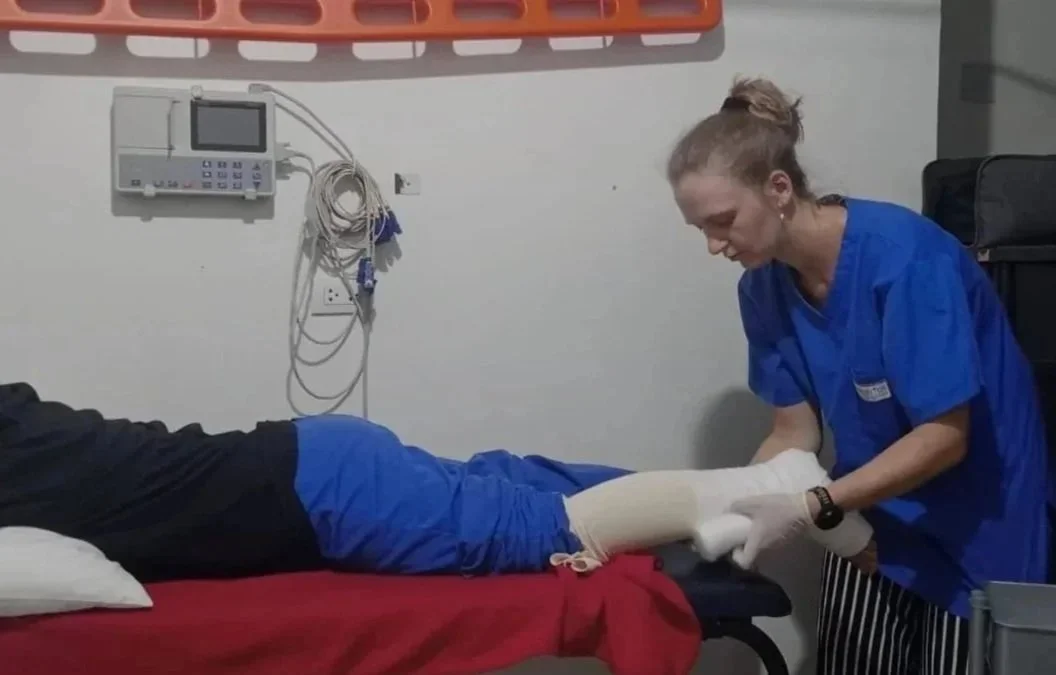
Hello. I’m Rebekka, a recently qualified German doctor volunteering with Integritas Healthcare within Philippine places of detention. My supervisor asked me to write a reflection on a particularly memorable patient. I’ve seen so many interesting cases, but it’s the people with stories behind their diagnoses who will stay with me the most…
Basics
Of course I have learned an incredible amount medically. For the first time I have been working in an environment where laboratory tests, ultrasound or x-rays are not readily available. Instead, I have had to learn to rely on what each patient tells me, on a careful physical examination, on very limited point-of-care tests (such as urinalysis), and on my clinical judgement. When the decision for or against a treatment depends on what you hear with your stethoscope or what you find during an examination, you suddenly listen and examine in a completely different way.
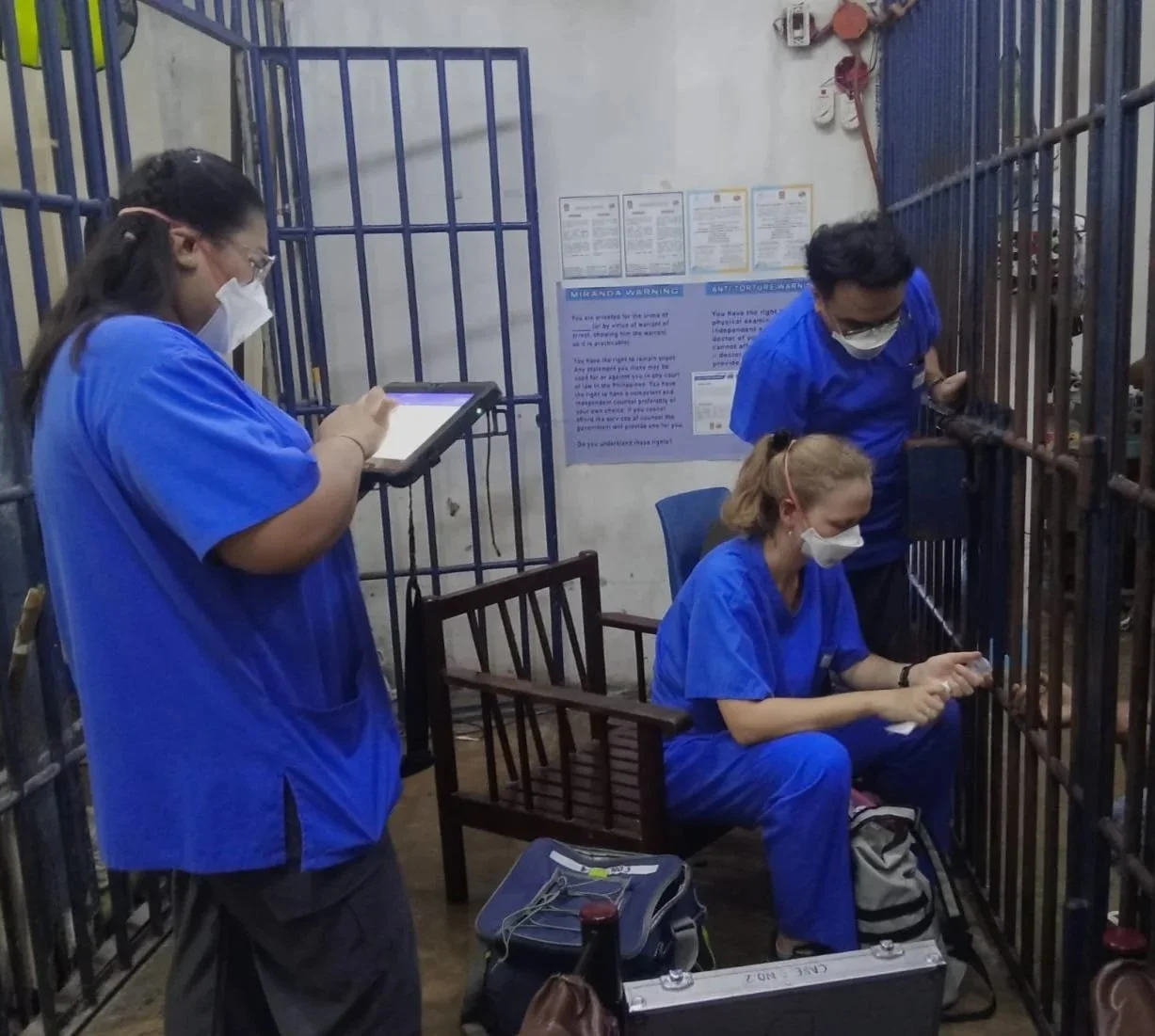
Rebekka and Filipino colleagues working cell-side using basic diagnostic kit
Yet at least as impactful have been the encounters with detained people. Here I have realised just how closely health and poverty are interconnected. How an easily treatable injury can become a life-threatening problem – because conditions are not diagnosed, treatments are too expensive, follow-up appointments are neither scheduled nor affordable, or nobody explains the vital importance of a particular treatment. Making matters worse in detention settings, difficult circumstances such as unclean cells, inadequate food supply, and a lack of privacy complicate things still more.
Sarah
One young woman - I’m going to call her Sarah - showed me this more clearly than anyone else.*
Like most other working days, we entered the cell area of a police station and began our medical check-ups in the men’s cell. The vast majority of police detainees are male. But while passing by the women’s cell, I noticed Sarah: she was in her early twenties, was obviously shy and frightened, and had multiple injuries to both legs.
In the dim light of the cell, my first thought was that she had committed deliberate self-harm (DSH). Sadly, this is not uncommon: especially in detention, people with mental health conditions often do not receive the psychosocial support that they need.
But this was not a case of DSH. Five days earlier she had been involved in a motorcycle accident. She couldn’t remember anything, but another person had died. So she had been arrested at the scene and taken via the local hospital to a police station.
Communication
Looking at Sarah five days after her accident, one of her ankles was severely swollen and floppy. A large wound on the heel of the same leg was uncovered and gathering dirt from the cell floor. I suspected a missed, possibly even open ankle fracture. She remembered the hospital staff taking an x-ray. But what had it shown? She did not know. Nobody had explained anything to her. And no follow-up had been arranged.
This made me stop and reflect. Good medicine is not just about diagnostics and treatments. It begins with people telling us their stories, then being helped to understand what is happening to their bodies and why certain treatments are necessary. Without proper communication, even the best medical care can fail.
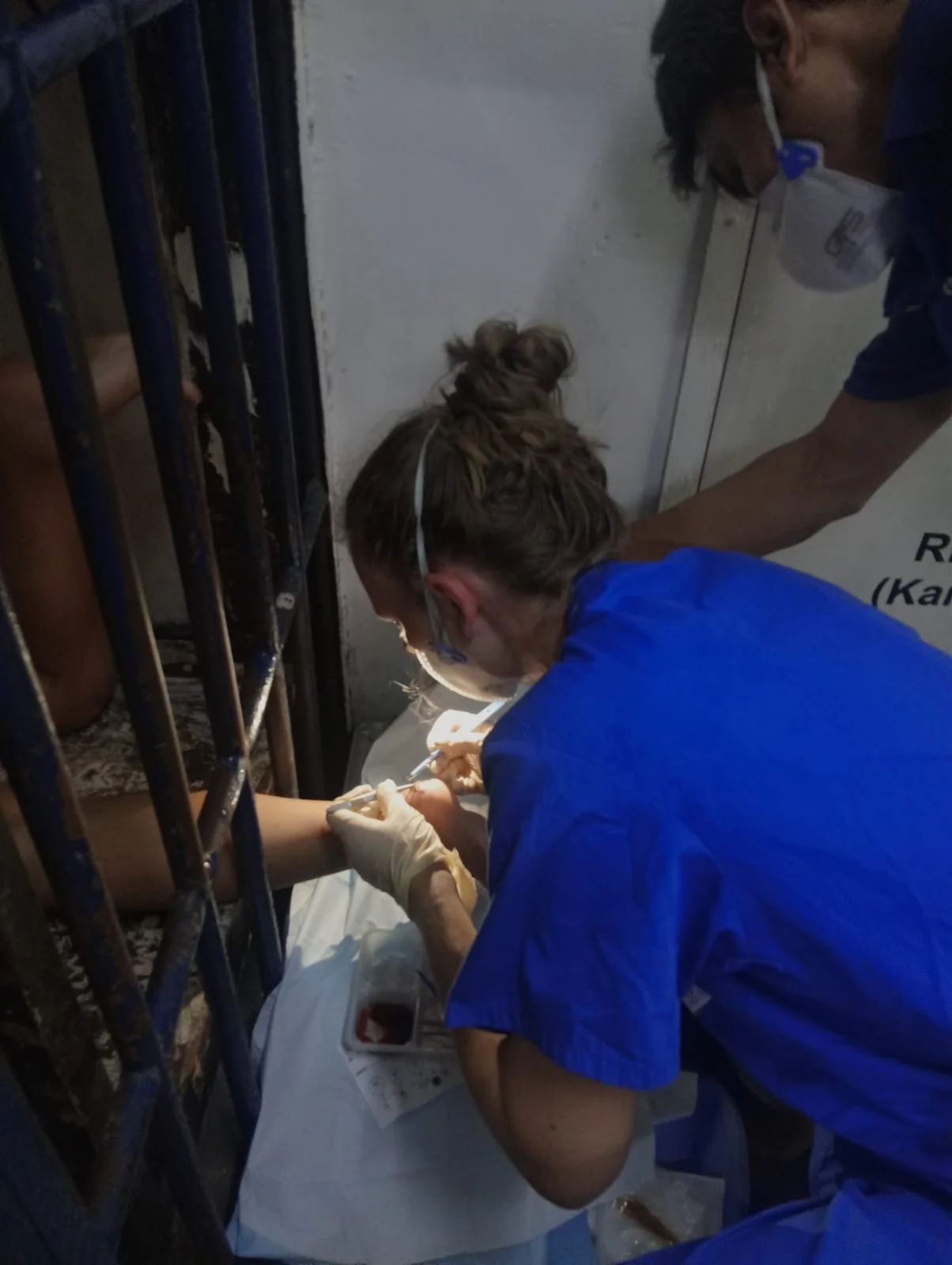
Rebekka debriding Sarah’s heel wound
First steps
We began by cleaning and debriding Sarah’s wound. As the officers would not allow us to open her cell door, we had to improvise through the bars whilst still trying to be as sterile as possible. And as her ankle was so very tender and I could not rule out a fracture, we provided her with stiff immobilisation bandaging and crutches. I also explained in detail why she must avoid putting weight through that foot.
Money
Soon though, it became clear that there was another problem. Sarah had initially been prescribed antibiotics at the hospital: three tablets a day for a week. But the branded formulation of the prescribed tablets was expensive and her family just could not afford them all. So she was taking just one occasionally, treating them more like painkillers for times of extremis. It wasn’t that she did not care about her health. It was simply because there was not enough money and she didn’t understand how courses of antibiotics should work.
Cheaper, generic versions of antibiotics work just as well as branded ones. They should never be taken inconsistently. And an incomplete course of treatment doesn’t necessary heal infection. It also increases the risk of antibiotic resistance – a problem that not only affects individual patients but also makes the worldwide treatment of bacterial infections more difficult. Yet many families face this same choice - to buy enough antibiotics for one sick loved one, or buy food for the whole household.
Still, thanks to the generosity of people who donate funds and supplies to Integritas, our police custody medical service was able to provide Sarah with everything she needs - and all free of charge.
Compliance
Our care for Sarah then transferred to our local clinic, due to her unexpected - though temporary - release from custody.
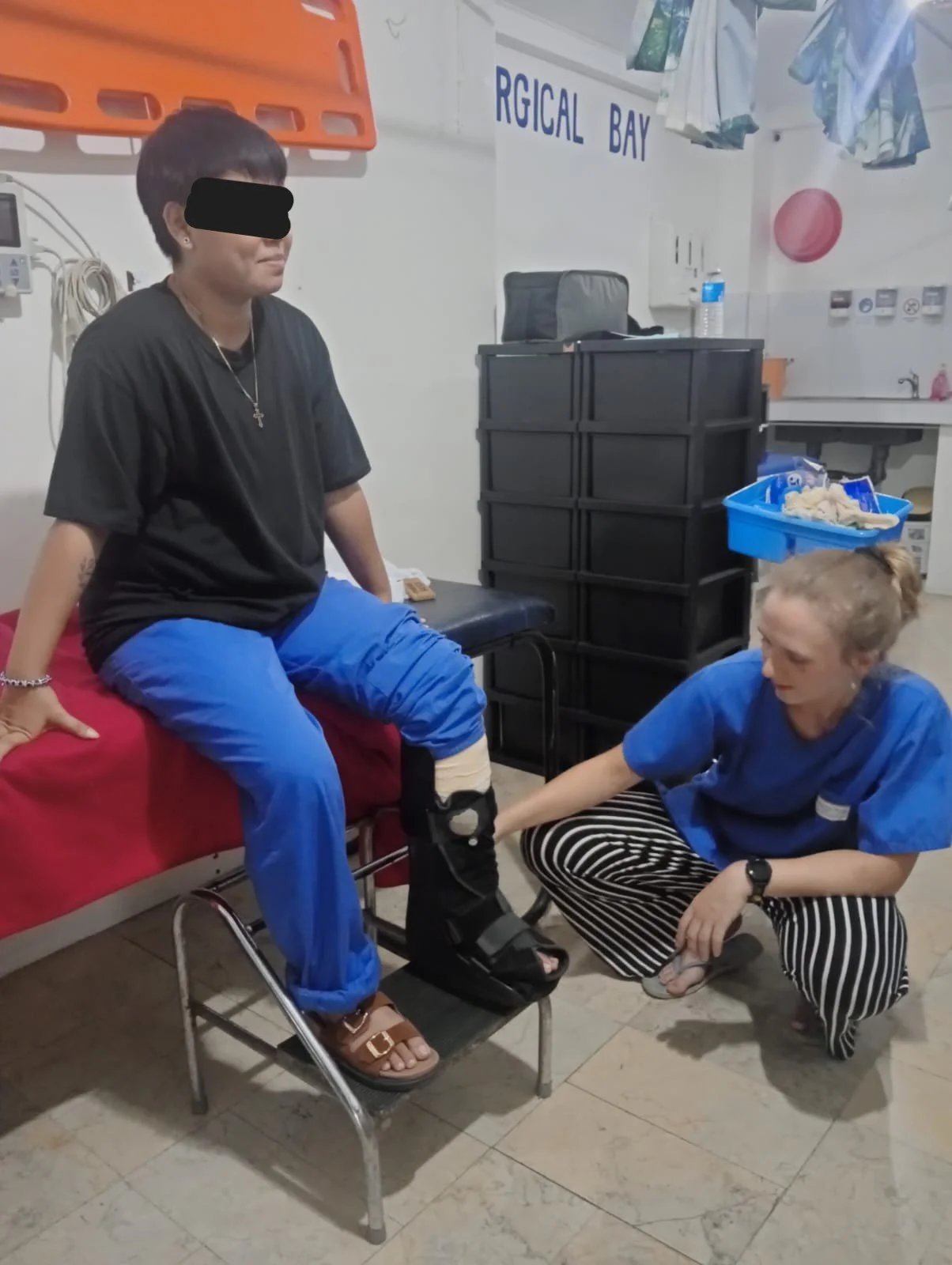
Sarah and Rebekka in our Philippines clinic, fitting an immobilising yet removeable orthotic to her leg
At that first clinic visit though, she arrived without her crutches! This wasn’t because she wasn’t taking our advice seriously. It was because - like many people with certain worldviews, limited finances and educational backgrounds - she considered her injury resolved once the worst of her pain had gone. Long-term consequences of incomplete treatment are difficult to appreciate when every additional medical visit creates additional transport and consultation costs. The everyday struggle of life still has to continue.
We went hunting for the report of the original x-ray, and found that it had indeed been reported as normal. So we took her along to the same hospital for another x-ray, though this time we interpreted the film ourselves. There was indeed a missed ankle fracture - a large avulsion (meaning the ligaments have been torn out of the bone) on the front and inside of the joint. She needed at least six weeks of immobilisation. But this requirement was complicated by her other important need - to have her badly injured heel re-dressed at regular intervals.
We took in-house advice from one of our advisory orthopaedic surgeons and fashioned an ankle immobilisation that could be removed weekly for further prone-positioned wound debridement and re-dressings.
Soon after this she was rearrested. So our care of her returned to being cell-based. Still, over the following weeks we continue to accompany her on her recovery journey.
Her wound continues to healslowly. She is not always consistent with her splint and crutches. So again and again, we have conversations with her to explain her injury, its healing process, and why patience was so important. Step by step, her adherence improves – not through pressure but because understanding grows when people feel heard and taken seriously.
Comparison
Why has Sarah’s story stayed with me? Maybe it’s because at some point I thought, ‘This could have been me’. We’re both female, in our twenties, and anyone can have an accident that changes your life in an instant. I could have been sitting there - injured, frightened, and alone in a dirty cell.
In my home country of Germany, someone who has had suffered loss of consciousness during a motor vehicle accident receives immediate, comprehensive trauma care. We are blessed to have state of the art ambulances, trauma bays, CT scans, monitoring, and comprehensive emergency treatments with follow-up pathways. And everyone receives this by default, regardless of whether they have funds or are about to be arrested. And prisoners receive the same standard of care as those in the community, again totally free of charge.
Of course, Germany and the Philippines should not be simply compared. The economic circumstances and available resources are completely different. Still, this case has made me humble. Back in Germany, the general public discusses its dissatisfaction with waiting times for out-patient appointments, healthcare bureaucracy and poor hospital food. And yes, many of these issues can and should be criticised. But sometimes my fellow citizens and I forget how extraordinary it is to live in a country where gold standard medical care is considered a basic expectation. For so many other people around the world, this is simply not the case. And our world’s 12 millions detainees have it far worst than most.
Dignity
A small NGO like Integritas could not hope to solve these structural problems. Even colossal NGOs like the International Committee of the Red Cross can’t achieve such feats! But helping Sarah as an individual was neither expensive nor difficult. It took a packet of antibiotics, a few dressings, a funded x-ray, a form of immobilisation and a pair of crutches. It did though take much time and presence. Someone needed to be hands on - taking a patient-centred history, making a thorough examination, looking carefully at the x-ray, repeatedly explaining the diagnosis and treatment program, and making some easy interventions.
Doing this has given Sarah the opportunity to recover from her injuries before going forwards to face the charges against her in a better state of health and dignity. Her likely alternative was a lifetime of painful limping around a jail cell. Or how about slow bone infection (known as osteomyelitis) requiring eventual amputation, or at worst blood poisoning leading to death?
That is exactly why the work of Integritas is about so much more than medical care. For people like Sarah languishing sick and forgotten in the corner of jail cells, such care is an empowering restorer of their human dignity.
Dr Rebekka Huebner is a resident doctor from Germany.
Her opinion does not necessarily represent that of Integritas Healthcare.
The English version of this article received a light edit from her supervisor.
The German language will be available shortly.
27th August 2026
*Sarah is a pseudonym but her story is shared with permission.