

Not alone
Alternatives to solitary confinement
Greetings from the Middle East where I’m on a half-work, half-holiday trip. I’ve attended a conference and am doing some other work. But I’m also taking a short holiday to celebrate a fairly major marital milestone to my husband Mark, a fellow prison doctor and the Chair of our UK Board.
Retrospective
Between the two of us, we have clocked up around 35 years of doctoring behind English bars. That’s more years than we’re marking in marriage! And as with our union, there is much to celebrate about our work. We are humbled to have been able to make small but (we hope and pray) positive differences in the lives of struggling fellow humans.
Yet, there are a few aspects of working within English prisons that have caused us uneasiness. Chief among these has been the the issue of segregation.
English prison doctors do ‘seg rounds’. Seg or Segregation is the English term for what most of the rest of the world calls solitary confinement. A prison doctor is obliged to visit every prisoner in his/her prison’s segregation unit every 72 hours, and a nurse visits every 24 hours. And, controversially as discussed later, nurses are still involved in the process of deeming a prisoner as ‘fit’ to enter segregation.
Helpful?
I also love teaching healthcare students about offender healthcare. And the London prison I’m working in currently has a brilliant initiative of welcoming a medical student every Monday, to shadow and ask questions. After taking one of them along to the segregation unit to watch me see a prisoner with a particular health complaint, I asked the officer in charge of the unit to let the student see the inside of an empty cell.
We sat on the concrete bed slab for a few minutes and looked around the bleak cell. And we talked about my job in general and about segregation in particular. After a few minutes, we moved on from practicalities to ethics: ‘Does being put here ever help someone?’ I paused for a moment to have a quick flick through my memory bank of countless Seg rounds and segregated patients. How do you think I replied?
Harmful

Using a torch to assess the oral hygiene of a long-term solitary prisoner held within an Asian darkened (ie no access to light) solitary unit
I’ve cared for thousands of patients in English solitary confinement units, and assessed many more (in a humanitarian capacity or as a medical expert) in various other places of detention around the world. I’ve seen the whole range of solitary conditions, from the very occasionally best-under-the-circumstances through to the frankly torturous. And I’ve got to know a significant minority of my patients quite well, as they have either been ‘frequent fliers’ (that is, prisoners who return repeatedly to solitary confinement) or else housed in solitary long-term (for example, the infamous Charles Bronson). So I’m in a good position to give a balanced answer to my student’s help v harm question.
Whilst I have seen a very few people improve mentally (and sometimes physically) on Seg, that’s been because they have not had easy access to the illicit drug trade that blights the English prison system. A break from drugs leads to an improvement in health. But that shouldn’t be a justification for sending a prisoner to solitary confinement. Indeed, there are other ways of helping such prisoners including sending them to a drug-free prison wing.
No, for the vast majority of my patients, segregation has been a net negative in health terms. For some, this net negative has been devastatingly large and chronic. And this is exactly what the prison system should expect: they recognise that solitary confinement is risky. Why else would they require a healthcare professional (HCP) to screen people upon entering it?
As pandemic lockdowns demonstrated to the majority of our species who have never been detained in prison, prolonged human isolation is unpleasant at best and devastatingly harmful at worst. There is now a massive body of evidence to support this assertion. But the modern research fields into offender healthcare and wider penology do not have the monopoly on such knowledge. In his seminal work, psychiatrist Dr Grassian reminded us that knowledge of the potential harm of solitary confinement dates back to the Victorian era at the very latest:
The openness with which these institutions were held up to public scrutiny led in time to open concern about the psychological effects of such confinement. During a tour of the United States in 1842, [English Victorian novelist] Charles Dickens wrote with pathos of the Philadelphia Prison:
The system here is rigid, strict, and hopeless solitary confinement. . . . Over the head and face of every prisoner who comes into the melancholy house, a black hood is drawn, and in this dark shroud, . . . he is led to the cell from which he never again comes forth, until his whole term of imprisonment has expired. He is a man buried alive . . . . dead to everything but torturing anxieties and horrible despair. . . . .
The first man I saw . . . answered . . . always with a strange kind of pause . . . . He gazed about him and in the act of doing so fell into a strange stare as if he had forgotten something.
In another cell was a German, . . . a more dejected, broken-hearted, wretched creature, it would be difficult to imagine. . . .
There was a sailor . . . . [w]hy does he stare at his hands and pick the flesh open, upon the fingers, and raise his eyes for an instant . . . to those bare walls . . .Psychiatric Effects of Solitary Confinement (emphasis added)
Torturous
The United Nations (UN) is unequivocal: prolonged solitary confinement, which the UN & CPT define as longer than 15 & 14 days respectively, may well amount to psychological torture:
These practices trigger and exacerbate psychological suffering, in particular in inmates who may have experienced previous trauma or have mental health conditions or psychosocial disabilities… The severe and often irreparable psychological and physical consequences of solitary confinement and social exclusion are well documented and can range from progressively severe forms of anxiety, stress, and depression to cognitive impairment and suicidal tendencies… This deliberate infliction of severe mental pain or suffering may well amount to psychological torture…
Nils Melzer, UN Special Rapporteur on torture (emphasis added)
Regarding the underlying question of the nature of psychological torture, I offer the forthcoming What is psychological torture? chapter from our introductory textbook on the field of torture and ill-treatment medicine.
Involvement
I’m writing this blog on Integritas Healthcare’s forum, and Integritas is a medical NGO. So let’s move on to consider how this information should affect doctors and other HCPs working behind bars. For example, what does the World Medical Association (WMA) - the collective conscience of the world’s physicians - think?
10. The physician’s role is to protect, advocate for, and improve prisoners’ physical and mental health, not to inflict punishment. Therefore, physicians should never participate in any part of the decision-making process resulting in solitary confinement, which includes declaring an individual as “fit” to withstand solitary confinement or participating in any way in its administration. This does not prevent physicians from carrying out regular visits to those in solitary confinement to assess health and provide care and treatment where necessary, or from raising concerns where they identify a deterioration in an individual’s health.
WMA Statement on Solitary Confinement 2019 (emphasis added)
The rationale for this goes as follows:
solitary confinement/segregation is a disciplinary sanction/punishment;
HCPs are healers not disciplinarians;
it has risks to health;
ergo HCPs should not be involved in sending a prisoner to it.
This principled stand is also found in other influential standards (emphasis added):
Health-care personnel shall not have any role in the imposition of disciplinary sanctions or other restrictive measures.
UN: Nelson Mandela Rules, rule 46(1)Medical practitioners in prisons act as the personal doctors of prisoners and ensuring that there is a positive doctor-patient relationship between them is a major factor in safeguarding the health and well-being of prisoners. The practice of prison doctors certifying whether a prisoner is fit to undergo solitary confinement as a punishment (or any other type of solitary confinement imposed against the prisoner’s wishes) is scarcely likely to promote that relationship. This point was recognised in the Committee of Ministers’ Recommendation Rec (2006) 2 on the Revised Prison Rules; indeed, the rule in the previous version of the Rules obliging prison doctors to certify that prisoners are fit to undergo punishment has now been removed. The CPT considers that medical personnel should never participate in any part of the decision-making process resulting in any type of solitary confinement, except where the measure is applied for medical reasons.
CPT: Solitary confinement of prisoners, paragraph 62
Alternatives
This week there was an online promotion of the International Guiding Statement on Alternatives to Solitary Confinement, authored by Antigone and Physicians for Human Rights Israel. Such is the importance of this issue, Mark and I took time out of our holiday in order to listen to it.
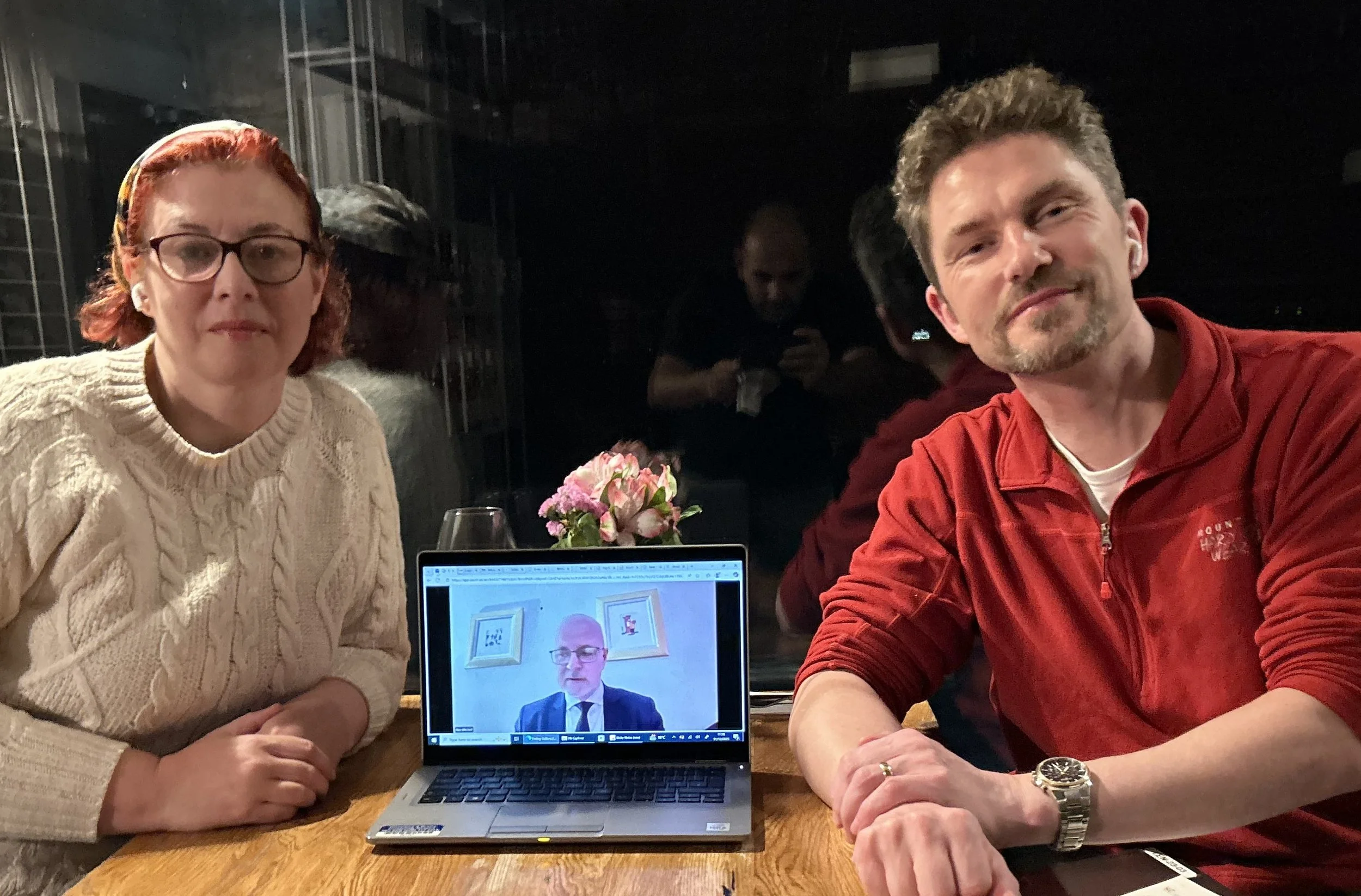
Listening in from the Middle East, to Dr Mitchell (President of the CPT) speaking on issues related to the International Guiding Statement
It was awe inspiring to hear about how the US State of Colorado went about minimizing the use of solitary confinement and abolishing its prolonged use. But most of us do not have such power and leverage in our roles as potential agents of change. Yet that does not mean we should just sigh and do nothing. No matter who we are or where in the world we live and work, we all have options:
Learn about the potential harms of solitary confinement, both short-term and prolonged:
Read the International Guiding Statement, about alternatives to solitary confinement.
If it is safe to do so, talk to colleagues - from both the healthcare and disciplinary sectors - about how solitary confinement does (and does not) ‘work’ at your place of detention.
If you’re a HCP, have a think about the ethical implications of your own involvement with the machinery of solitary confinement.
Do quality improvement work into this issue.
Again if it is safe to do so, go and talk to your line manager. What, if anything, could your team do differently within the constraints of the existing system?
If you’re in a position of influence, talk wisely about this issue with your contacts and peers.
It’s hard when you’re just one tiny cog within a gargantuan machine. But collectively we can make a difference. Integritas is starting to consider its own strategy in pushing for meaningful change, and we’ll update you in due course. For now though, let me close with a gentle plea…
Wherever you are in the world, and regardless of whether you work on the disciplinary or the healthcare side of a place of detention, try to demonstrate kindness and respect to each prisoner in solitary confinement. Every time you do this, you will help - in a very small but meaningful way - to mitigate against the enormous psychological stress (s)he is under. This is something that we can all do.
Dr Rachael Pickering is our Chief Medical Officer. Her views do not necessarily represent those of Integritas Healthcare.
It is not good for the man to be alone…
Genesis 2:18